SEO and AI search for multi-location businesses
One Business Profile and location page per site, consistent name and address, then weekly checks on how AI engines talk about you.
Multi-location SEO is the work of helping each store, office, or franchise show up for the place it actually serves. Searchers type a city, a neighborhood, or "near me," and AI answers now recommend businesses the same way. The classic work still matters: one Google Business Profile per location, a precise name and address, location pages, reviews, and local content. The newer work is checking whether AI engines name you or a competitor.
What multi-location local SEO covers
Multi-location local SEO is not one national page trying to rank for every city. Each location needs its own presence that matches how the business appears in the real world. Google's Business Profile guidelines are the base layer: represent the business as it is consistently represented on signage, stationery, and other branding, keep the address or service area accurate and precise, and keep one profile per business so Maps and Search do not show conflicting information.
For a brand with several sites, that usually means a profile for each real-world location, a page on your website for each one, and social or local content that uses the same name and address. Multi-location marketing is the wider version of the same idea: the offer can be shared, but the place, hours, and proof have to be local.
One Google Business Profile per location
Create your Business Profile for the actual, real-world location, and use a precise, accurate address or service area. Google's guidelines are explicit: do not create more than one page for each location of your business, either in a single account or multiple accounts. Duplicate profiles for the same shop split reviews, hours, and signals, and they can cause problems with how the information displays on Maps and Search.
Name, address, and phone should match the way the business is known to customers. Google says your name should reflect your business's real-world name, as used consistently on your storefront, website, stationery, and as known to customers. Write the same name and address on the profile, the location page, and the directions you share in posts. That consistency is what people often call NAP (name, address, phone).
Manage many locations in bulk when you qualify
If your business has 10 or more locations, Google says you can add, verify, and manage them in bulk. The official path is Business Profile Manager: create a business group, put every location in a spreadsheet, upload it, fix errors, and request bulk verification. Locations are not eligible to appear on Search, Maps, and other Google properties until they are verified, so keep the sheet current as shops change.
Google's bulk-verification help also states a limit that agencies should plan around: you can bulk-verify when the spreadsheet has 10 or more profiles from the same business, and agencies with more than one business in one account can't bulk verify. Treat each brand's locations as their own set, and follow Google's current help when you submit.
Location pages, reviews, and local content
A location page on your site should describe that place, not a lightly rewritten copy of the homepage. Include the same name and address you use on that location's Business Profile, plus details unique to that shop or office, and a clear way to get directions or book. Local content can be a page or a post about something that actually happened at that site, not generic city copy repeated across dozens of URLs.
Reviews live on each location's profile, so the replies should too. Answer the review for that shop, in that shop's voice, and fix facts that are wrong. For a walkthrough of the reply itself, see how to respond to Google reviews. Fresh, accurate hours and photos on the profile help as much as a new blog post.
Multi-location marketing and social media franchise marketing
Multi-location marketing and social media franchise marketing fail in the same way: a single caption ships to every page, with a name or address that only fits the flagship. The brand can stay consistent, and the local facts still have to be local. Use the same real-world name Google asks for on the profile, then write posts that a customer of that location would recognize: the hours, the offer, the staff, the neighborhood.
The address and the day-to-day posts still belong to that site. Keep a review step so a local manager can catch a copied caption that names the wrong city before it goes out.
How AI answers change the job
People also ask ChatGPT, Gemini, Google AI Overviews, Claude, and Perplexity where to go. Those answers may name a brand, cite a page, or recommend a competitor. Multi-location SEO still needs strong local pages and profiles, because those are the pages an engine can cite. The extra job is to watch the answers themselves, market by market, instead of guessing from a few manual prompts.
How to rank in AI search and a roundup of AI visibility tools cover the wider practice. The practical loop for a multi-location brand is narrower: pick the buyer questions people ask in your market, publish location-accurate pages and posts, and check whether the engines name you or a competitor for those questions.
Where Mark fits
Mark drafts your content and social posts, and tracks how you show up in search and AI answers. Once a week, Mark asks each active buyer question in each market on six AI engines: ChatGPT, Gemini, Google AI Overview, Google AI Mode, Claude, and Perplexity. You can also track up to 50 competitors and compare how often AI answers name and cite them and you. You approve every piece before it goes live.
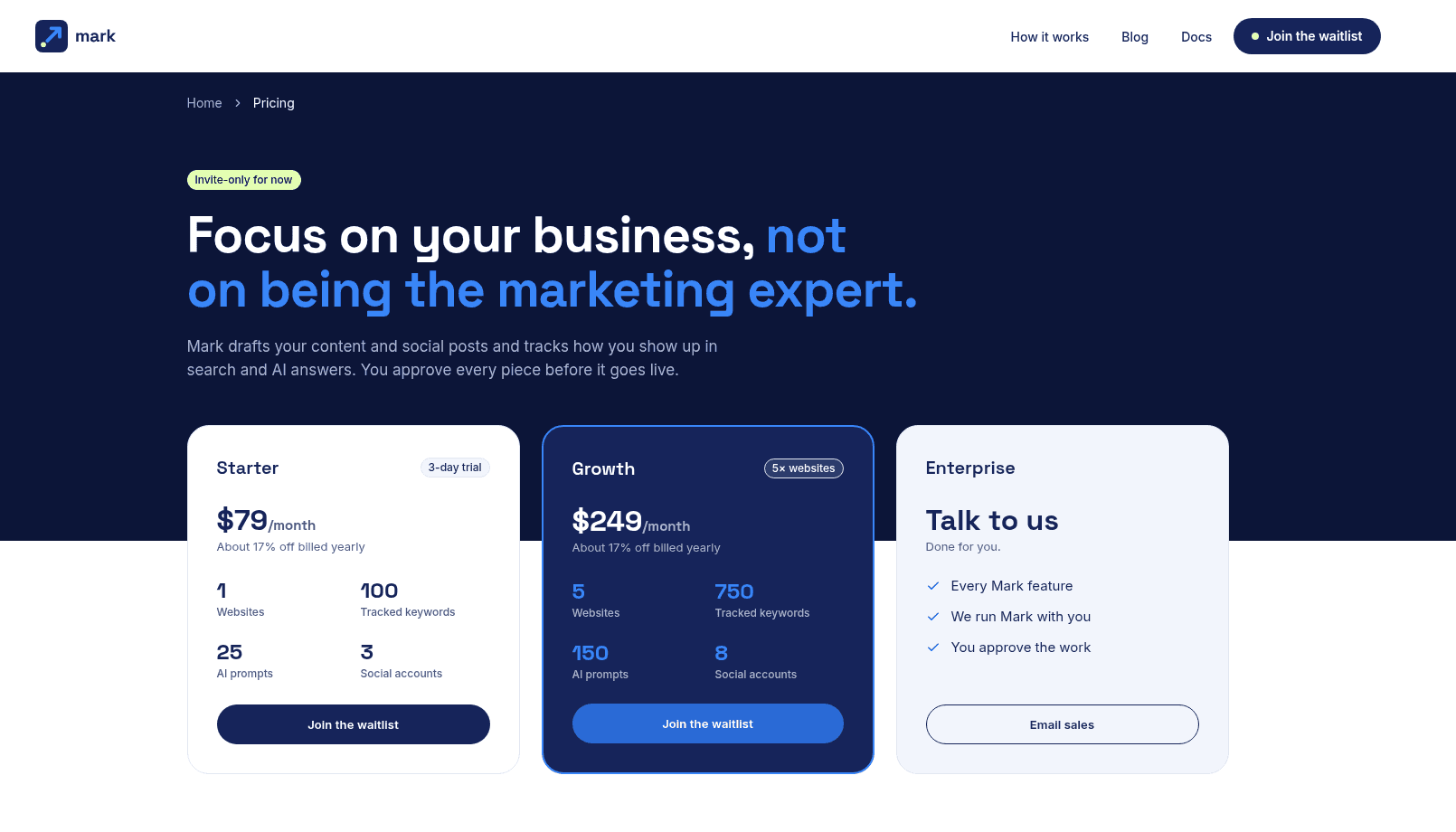
A market in Mark is a place you prioritize: its country, the language people search in, and its local time zone. Keyword research and the weekly answer-engine check use it to know where to look. Starter is $79/mo, and Growth is $249/mo, with about 17% off when you pay yearly. Growth includes 5 websites, 750 tracked keywords, 150 AI prompts, and 8 social accounts.
If you want a seat, join the waitlist.
Sources
- Guidelines for representing your business on Google (one profile per location, accurate name and address)
- Bulk location management overview
- Verify Business Profiles in bulk
- Mark docs: Track AI answers
- Mark docs: Research competitors
- Mark docs: Set up your strategy (markets)
- Mark homepage and Mark pricing (checked 18 November 2026)