Best AI Visibility Tools for Small Business in 2026: 7 AEO Tools Compared
The best AI visibility tools for small business in 2026, compared: engines tracked, prompts and starting prices for Mark, Otterly, HubSpot AEO, Peec and more.
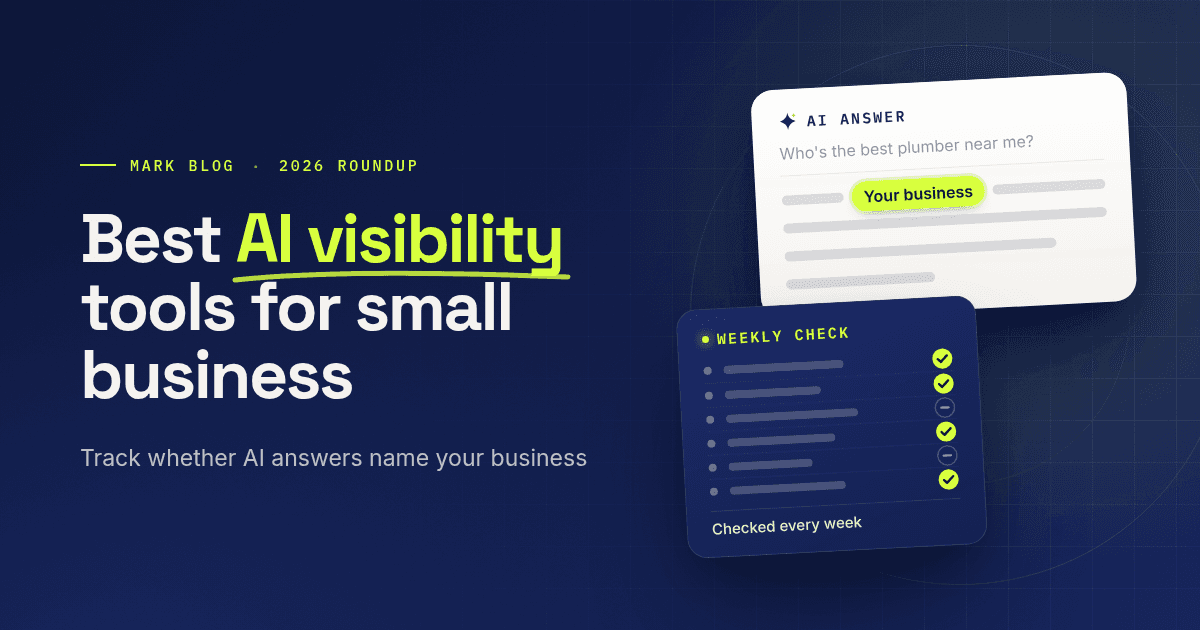
The best AI visibility tools for small business in 2026 are Mark, OtterlyAI, HubSpot AEO, Peec AI, Scrunch, AthenaHQ and Profound. Each one asks AI assistants such as ChatGPT, Gemini, Perplexity and Google's AI Overviews the questions your buyers ask, then records whether the answers name or cite your business. On the vendor pricing pages we checked on October 29, 2026, paid plans start at $29 a month and reach $295 a month, with custom pricing for enterprise. The prices cover different amounts of work. Most of these tools focus on tracking AI answers. Mark also drafts content, schedules social posts and reports social media analytics.
What is an AI visibility tool?
An AI visibility tool, also called an AEO tool, GEO tool or LLM SEO tool, tracks how AI answer engines talk about your business. You give it a list of prompts, the questions a buyer might type into ChatGPT or Gemini, and it runs them on a schedule. For each answer, the tool records whether your business is mentioned, which competitors appear, and which websites the engine cited as sources.
The three names describe the same job. AEO stands for answer engine optimization, GEO for generative engine optimization, and LLM SEO for search optimization aimed at large language models. HubSpot's own AEO page lists AI SEO, GEO, AI visibility optimization and LLM optimization as other names for the same discipline.
Most tools in this guide report three things:
- Visibility: how often your business shows up across your tracked prompts.
- Competitors: who AI answers recommend instead of you, or alongside you.
- Citations: which pages and domains the engines cite, so you know what content to create or update.
Best AI visibility tools compared
The table compares each tool's entry plan as listed on its pricing page on October 29, 2026. Engines are the AI assistants each entry plan tracks; several vendors add more engines on higher plans or as paid add-ons. Prices are monthly unless noted.
Compare prices with scope in mind. Most tools here cover one job, tracking AI answers. Mark covers AI visibility, content creation, content scheduling and social media analytics, so setting its price next to a tracker's compares different products.
Tool | Best for | Engines on the entry plan | Entry plan includes | Starting price |
|---|---|---|---|---|
Mark | Small businesses that want AI answer tracking, content and social in one tool | ChatGPT, Gemini, Google AI Overviews, Google AI Mode, Claude, Perplexity | 25 AI prompts checked weekly, 1 website, 100 tracked keywords, 3 social accounts, content drafting and social publishing | $79/mo (Starter); 3-day trial |
OtterlyAI | The lowest-cost dedicated tracker | ChatGPT, Google AI Overviews, Perplexity, Microsoft Copilot (Claude, AI Mode and Gemini as add-ons) | 15 search prompts tracked daily, unlimited team members | $29/mo (Lite) |
HubSpot AEO | HubSpot users and anyone who wants a simple standalone tracker | ChatGPT, Gemini, Perplexity (Claude, AI Mode and AI Overviews in a beta) | 25 prompts tracked daily, citation analysis, recommendations | $50/mo, or $45/mo paid yearly |
Peec AI | SEO and content teams that want detailed daily tracking | 3 active models from ChatGPT, AI Mode, AI Overviews, Copilot, Gemini and Naver AI | 50 prompts tracked daily in 1 country | $95/mo (Starter) |
Scrunch | Teams that want site audits alongside tracking | ChatGPT, Perplexity, Google AIO, Copilot | 125 prompts, 5,000 responses a month, 5 site audits a month | $250/mo (Core) |
AthenaHQ | Teams that want wide model coverage | 11 models, including ChatGPT, Perplexity, AI Overviews, AI Mode, Gemini and Claude | 3,600 credits a month (1 credit = 1 AI response) | $295/mo (Starter); free Essential plan |
Profound | Larger brands with an enterprise budget | Trial: ChatGPT, Gemini, Google AI Overviews; Enterprise: up to 9 engines | Trial: 50 prompts daily for 7 days | Custom (Enterprise); no-cost Trial tier |
The tools, one by one
Each entry below covers who the tool fits, what the entry plan includes, and the starting price from the vendor's pricing page on October 29, 2026. Mark is first because we make it; the rest follow from the lowest starting price to the highest. For a small business, the questions that matter most are which engines the plan covers, how many prompts you get, and whether the tool helps you act on what it finds.
Mark
Best for: small businesses that want to see how AI answers describe them and fix it in the same place.
Starting price: $79 a month for Starter, with a 3-day trial. Growth is $249 a month for 5 websites, 150 AI prompts and 8 social accounts.
Every week, Mark asks each of your buyer questions on six AI engines: ChatGPT, Gemini, Google AI Overviews, Google AI Mode, Claude and Perplexity. For each answer, Mark records whether your business is named, which competitors are named, and whether one of your pages is cited. Keyword rankings, Search Console and site analytics sit next to those results.
Mark also covers the work that follows. Mark drafts blog posts, FAQ pages, competitor pages and landing pages from your own photos and notes, checks every fact against a confirmed source, and sends approved pages to your website CMS. Social posts are drafted the same way and publish to your connected accounts on the schedule you set. A person approves each piece by default, and every plan includes every feature.
That puts Mark in several categories at once: AI visibility, content creation, content scheduling and social media analytics. The other tools in this guide focus on AI visibility, so a business that also wants content and social help would add separate tools for that work.
OtterlyAI
Best for: owners who want the lowest-cost dedicated AI search tracker.
Starting price: $29 a month for Lite. Standard is $189 a month for 100 search prompts and adds AI search optimization recommendations.
OtterlyAI Lite tracks 15 search prompts daily on ChatGPT, Google AI Overviews, Perplexity and Microsoft Copilot, with Claude, Google AI Mode and Gemini available as paid add-ons. Lite includes brand visibility and sentiment analysis, citation source tracking and unlimited team members. OtterlyAI's pricing FAQ says new users get a trial and that subscriptions are monthly, so you can cancel any time.
HubSpot AEO
Best for: HubSpot customers, and anyone who wants a simple standalone tracker from a large vendor.
Starting price: $50 a month, or $45 a month paid yearly, with no other HubSpot subscription required.
HubSpot AEO tracks 25 prompts daily on ChatGPT, Gemini and Perplexity. The plan includes a brand visibility score, competitor share of voice, citation analysis and prioritized recommendations. HubSpot's knowledge base says you can add Claude, Google AI Mode and Google AI Overviews through its AEO Multi-Engine beta, which draws on extra answer capacity. HubSpot offers a 28-day trial with no credit card, and a free one-time AEO Grader snapshot. Marketing Hub Professional and Enterprise include AEO as well.
Peec AI
Best for: SEO and content teams that want detailed daily tracking and source analysis.
Starting price: $95 a month for Starter.
Peec AI Starter tracks 50 prompts daily on 3 active models, chosen from ChatGPT, AI Mode, AI Overviews, Microsoft Copilot, Gemini and Naver AI, in 1 country. Starter includes visibility, position, sentiment and share of voice against competitors, gap analysis, recommended actions, a crawlability audit and AI referral tracking. Team users and competitors are unlimited on every plan.
Scrunch
Best for: teams that want site audits and page optimization alongside tracking.
Starting price: $250 a month for Core.
Scrunch Core includes 125 unique prompts, 5,000 responses a month and 5 site audits a month across ChatGPT, Perplexity, Google AIO and Copilot, with 5 user licenses. Core also covers citations, sentiment analysis, AI bot traffic, insights and recommendations, and one page optimization a month. Scrunch Enterprise expands coverage to 9 LLMs, including Claude, Gemini and Google AI Mode.
AthenaHQ
Best for: teams that want the widest model coverage on a self-serve plan.
Starting price: $295 a month for Starter, with a free Essential plan that includes 300 credits.
AthenaHQ Starter includes 3,600 credits a month, where 1 credit equals 1 AI response, with visibility across 11 models such as ChatGPT, Perplexity, AI Overviews, AI Mode, Gemini, Claude, Copilot and Grok. Starter has unlimited topics, prompts and competitors, plus a content optimization agent. AthenaHQ labels Starter as best for self-guided SMBs.
Profound
Best for: larger brands that want enterprise-grade tracking and AI marketing agents.
Starting price: custom pricing for Enterprise. The Trial tier costs nothing.
Profound's Trial runs 50 prompts daily for 7 days on ChatGPT, Gemini and Google AI Overviews, with limited AI Marketer credits. Enterprise tracks up to 9 answer engines, with a tailored prompt plan, dedicated support and SSO. Profound also positions its AI Marketer agents for research, campaign planning and content writing.
How to choose an AI visibility tool for a small business
Choose an AI visibility tool by matching four things to your business: the AI engines your customers use, how many questions you need to track, your monthly budget, and whether you also need help creating the content that earns mentions. A local service business tracking a handful of buyer questions has different needs from a brand tracking hundreds of products in several countries.
- List your buyer questions first. Write the 10 to 25 questions a customer might ask an AI assistant before choosing you, such as "best plumber in Austin" or "what software do small accounting firms use." The count tells you which plan size fits.
- Check engine coverage on the plan you'd buy. Several vendors include fewer engines on entry plans and charge for others as add-ons or on higher plans. Make sure the engines your customers use are included at your price.
- Look at what happens after the report. Tracking shows the gap. You still need pages, FAQs and posts that answer those questions. Decide whether you want recommendations, content drafting, or both.
- Give it time. AI answers change from run to run. HubSpot's knowledge base advises reviewing performance across multiple days or weeks before judging trends.
Is there a free AI visibility tool?
Yes, but the free options are limited in time or volume. AthenaHQ's Essential plan is free and includes 300 credits. HubSpot's AEO Grader is a free, one-time snapshot of your visibility on ChatGPT, Perplexity and Gemini, and HubSpot AEO itself has a 28-day trial with no credit card. Profound's Trial plan runs 50 prompts daily for 7 days, and OtterlyAI offers a trial to new users. Mark Starter has a 3-day trial.
A free check is a sensible first step: it shows whether AI answers mention your business at all. Ongoing tracking is where the value builds, because you see whether new pages and posts change the answers over the following weeks.
FAQ
What is the best AI visibility tool for small business?
The best AI visibility tool for a small business depends on what you need beyond tracking. OtterlyAI Lite at $29 a month is the lowest-cost dedicated tracker we found, and HubSpot AEO at $50 a month suits HubSpot users. Mark Starter at $79 a month tracks six AI engines weekly and also drafts your content, schedules your social posts and reports social analytics, with a 3-day trial.
What are LLM SEO tools?
LLM SEO tools are AI visibility tools by another name. They track how large language models such as ChatGPT, Gemini and Claude answer questions about your category, whether they mention your business, and which sources they cite. The tools in this guide all do that job.
What is the difference between AEO tools and GEO tools?
There's no practical difference. AEO (answer engine optimization) and GEO (generative engine optimization) both describe getting your business named and cited in AI-generated answers, and vendors use the terms interchangeably. HubSpot's AEO page lists GEO, AI SEO and LLM optimization as other names for the same discipline.
Which AI engines should a small business track?
Track the engines your customers use. ChatGPT, Perplexity and Google's AI Overviews appear on most entry plans above. Coverage of Google AI Mode, Gemini and Claude varies the most: Mark Starter and AthenaHQ Starter include all three, while other vendors offer some of them as add-ons, beta features or higher-plan engines. Mark tracks all six engines every week on every plan.
How many prompts does a small business need?
Start with the core questions buyers ask before choosing a provider in your category and area, then add more as you learn which ones matter. Entry plans in this guide include 15 (OtterlyAI Lite), 25 (Mark Starter and HubSpot AEO), 50 (Peec AI Starter) and 125 (Scrunch Core) prompts.
Do AI visibility tools improve my rankings in ChatGPT?
No tool can guarantee that ChatGPT or any other engine will mention you. AI visibility tools show where you appear, where competitors appear instead, and which sources the engines cite. You improve visibility by publishing clear, sourced pages and posts that answer your buyers' questions, then checking whether the answers change.
One tool for tracking, content and social: Mark at $79 a month
Mark gives a small business weekly AI-answer tracking across ChatGPT, Gemini, Google AI Overviews, Google AI Mode, Claude and Perplexity, plus content creation and social scheduling, in one tool for $79 a month on Starter. Dedicated trackers in this guide start at $29 a month and reach $295 a month or custom pricing, and they focus on tracking. Social scheduling and social analytics would mean separate tools. You can try Mark Starter with a 3-day trial.
With Mark, the same workspace that shows which buyer questions name a competitor instead of you drafts the blog post, FAQ page or social post that answers them. You approve each draft, Mark checks its facts against confirmed sources, and approved pages go to your website while approved posts publish on your schedule. Keyword rankings, Search Console and site analytics sit next to the AI answer results, so you can see what changed after you published.