You don't need an enterprise budget to see what AI says about your business
Salesforce launched Palmata to show brands how AI describes them. A small business can see the same thing today, from $29 a month. Here are our own numbers.
You can see what AI says about your business today, and it does not take an enterprise contract. Salesforce just announced Palmata, which came to it through the Contentful acquisition. Palmata shows a brand what ChatGPT, Gemini, Claude and other AI assistants say about it. The problem Palmata names is real and contemporary. Just know that this idea is not novel, nor does it belong only to companies that have Enterprise-level budgets. Small-business tools that do the tracking start at $29 a month, and the first check costs nothing.
The announcements, and what's left unsaid
Palmata is Salesforce's new product for tracking how AI assistants describe a company. In his LinkedIn announcement, Salesforce CEO Marc Benioff said Palmata shows what the AIs are saying about your company, the sources shaping each answer, and what to change. He also said it simulates the impact of a change before you publish.
The post does not list a price, as costs are gated behind an Enterprise engagement for "custom quoting". You do not have to wait for a Salesforce sales cycle to find out how AI sees your business, and you certainly don't need to pay the amount behind the curtain.
The post ends with "Goodbye SEO." Obviously we disagree with that too. Google's own Search Central guide says there are no additional requirements or special optimizations to appear in AI Overviews or AI Mode, and that SEO best practices still apply. The basics still do the work. Modifications to conventional tracking tell you whether they are working.
Past all of the marketing hoopla, AI visibility (i.e. AEO and GEO) is simply a modernization of SEO to incorporate how LLMs and AI agents behave. That doesn't mean it's the death of SEO or the start of anything fundamentally new. That said, it's worth noting specifically how things change with AI front and center in your go-to-market strategy.
Why what AI says about your business matters
People now ask an AI assistant which business to pick, and the answer does not show up in your analytics. A buyer types "who is the best roofer near me" or "which tool should I use for payroll" into ChatGPT. The assistant names two or three businesses. If yours is not one of them, you never see the visit you lost.
AI visibility is the name for how often those answers name your business or link to your site. A tracking tool asks the assistants the questions your buyers ask, on a schedule, and records three things: whether you were named, which competitors were named, and which pages the answer cited.
What it costs to track AI answers
Tracking AI answers for a small business costs between $29 and $295 a month on the entry plans we have checked, and one tool has a free plan. These are the prices each vendor listed on its own pricing page when we checked them in October and November 2026.
Tool | Entry plan | What it includes |
|---|---|---|
OtterlyAI | Lite, $29 a month | 15 search prompts, tracked daily |
HubSpot AEO | $50 a month | 25 prompts on ChatGPT, Perplexity and Gemini |
Mark | Starter, $79 a month | 25 AI prompts, checked weekly on six engines, plus content and social |
Peec AI | Starter, $95 a month | 50 prompts on 3 models |
Scrunch | Core, $250 a month | 125 prompts |
AthenaHQ | Starter, $295 a month | 3,600 credits, plus a free Essential plan with 300 credits |
Profound does not publish a price for brands. Its pricing page lists a free 7-day trial and a custom Enterprise plan. We compare these tools in more detail in Best AI visibility tools for small business.
How to check what AI says about you for free
You can run the first check yourself in about the time it takes to drink a coffee. This is our suggestion, not a study.
- Write down five questions a buyer would ask before choosing a business like yours. Use their words, not yours.
- Ask each question in ChatGPT and in Gemini. Do not mention your business name.
- For each answer, note whether it named you, who it named instead, and which sites it linked to.
- Ask one more question that does include your name, such as "What does [your business] do?" Check the answer for mistakes.
HubSpot also offers a free AEO Grader as a one-time diagnostic. AEO stands for answer engine optimization, the practice of getting AI answers to name and cite you.
A manual check shows you one moment. Answers change from week to week and from engine to engine, which is the reason to track them on a schedule once you know the questions that matter.
What Mark shows, using our own numbers
Mark runs the check for you every week. Once a week, Mark asks each of your active buyer questions on six AI engines: ChatGPT, Gemini, Google AI Overview, Google AI Mode, Claude and Perplexity. The Performance page then opens on one AI visibility score, which is how many of that week's answers name or cite you, out of 100.
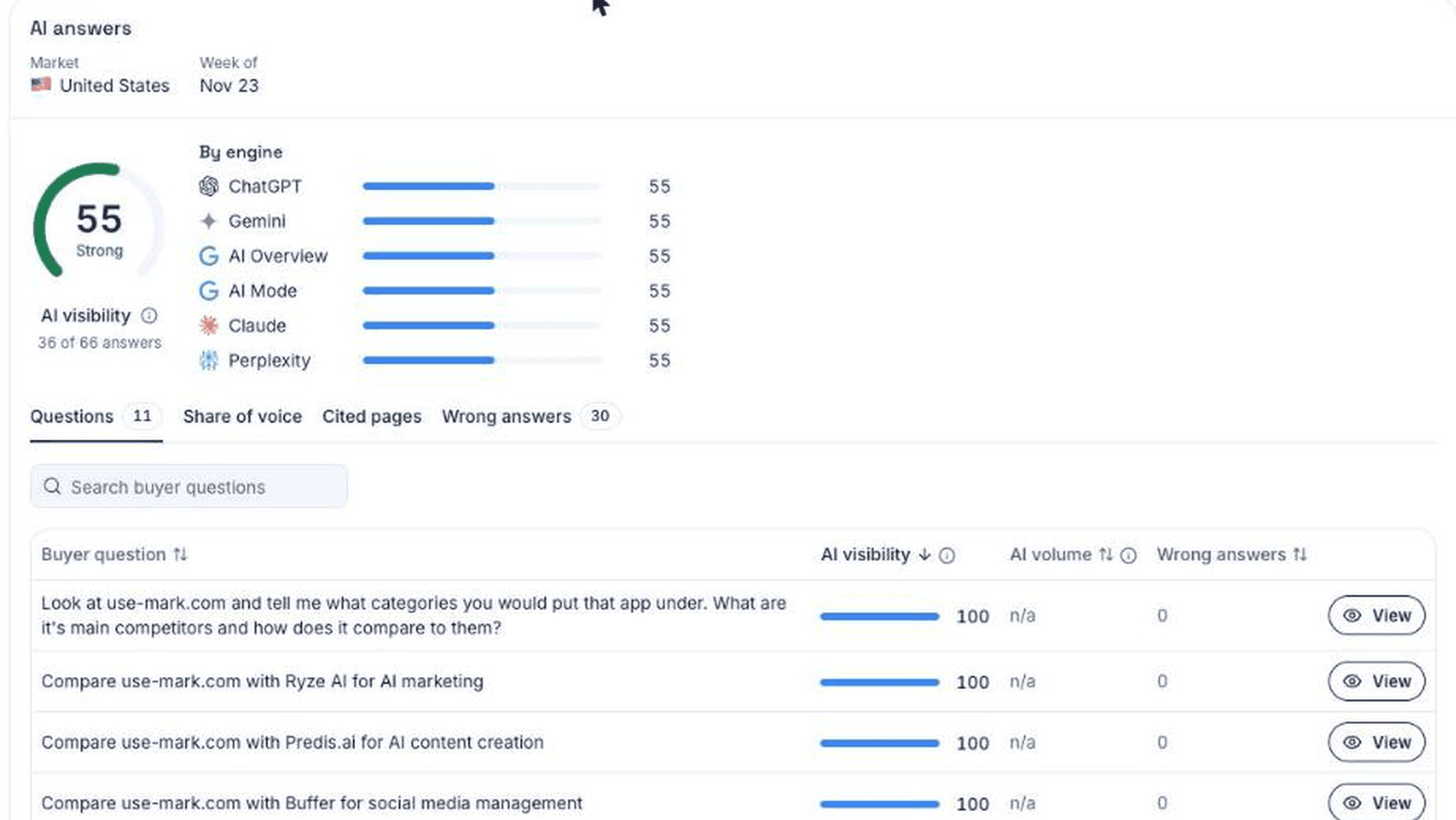
Here is Mark's own workspace for the week of November 23, 2026, in the United States market:
- AI visibility score: 55 out of 100. AI named or cited Mark in 36 of 66 answers, from 11 buyer questions on six engines.
- Questions that mention us: six questions such as "Compare use-mark.com with Buffer for social media management" scored 100.
- Questions that don't mention us: five category questions such as "What are the best AI tools for marketing?" scored 0.
- Wrong answers: 30 open, each one an answer that named a competitor instead of Mark.
The score for each question is where this gets useful. When a question includes our name, the assistants find us. Open questions about the category are where we have room to grow, so those are the pages we write next.
Mark also lists the pages those answers cite, yours and third-party ones, so you can see which sources shape the answer.
Mark does not simulate the effect of a change before you publish, which Salesforce says Palmata does. Mark shows the answers, the cited pages and the wrong answers, and it drafts the content you approve in response.
What to do this week
Write your five buyer questions and ask them in ChatGPT and Gemini today. If the answers name you, keep doing what you are doing. If they name a competitor, you now know the question to answer on your own site. AI answer tracking is on every Mark plan, and you can see the limits on the pricing page.