AEO vs GEO: what each means and where they differ
AEO vs GEO explained: what each term means, where they overlap, what Google and the GEO research say, and how to check if AI answers name your business.
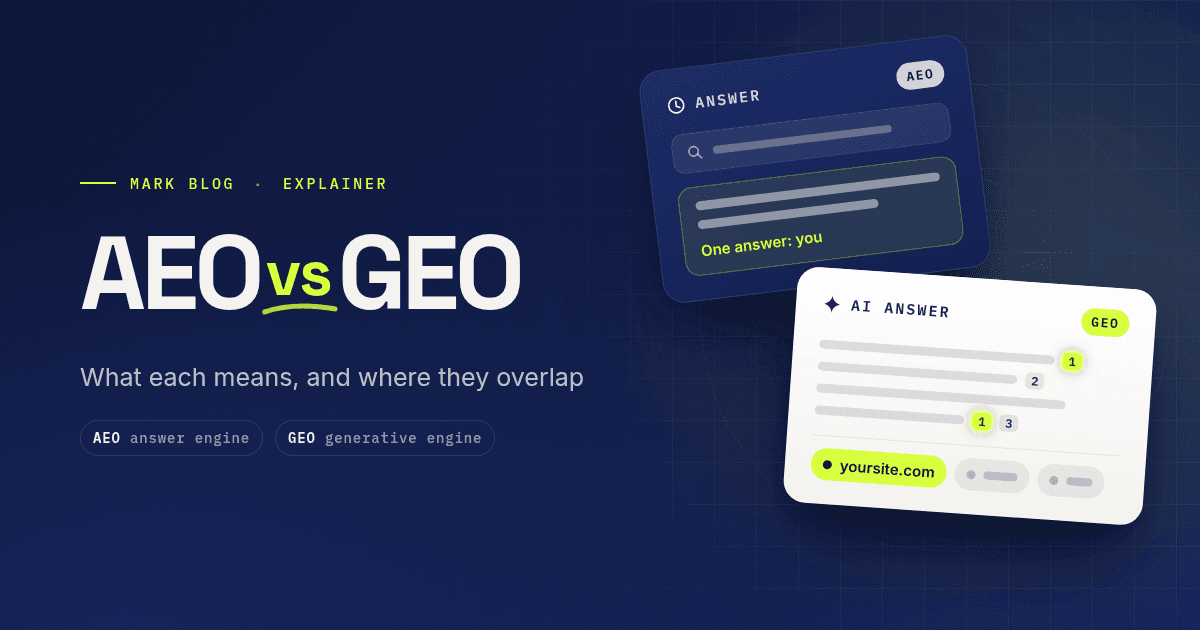
AEO vs GEO is mostly a question of names. AEO, short for answer engine optimization, is the older term for making your content the direct answer a search engine, voice assistant or AI tool gives to a question. GEO, short for generative engine optimization, is the newer term for getting your content cited or mentioned inside answers written by AI models such as ChatGPT, Perplexity and Google AI Overviews. Google's own Search Central guide, published in May 2026, defines both terms and says that, from Google Search's perspective, optimizing for generative AI search "is optimizing for the search experience, and thus still SEO."
The two terms describe overlapping work with different histories. AEO grew out of featured snippets and voice search around 2017 and 2018. GEO was named in a 2023 research paper from Princeton University and IIT Delhi that tested how content changes affect visibility in AI answers. Below, we cover what each term means, where AEO and GEO differ, what Google and the research say, and how a small business can act on both.
AEO vs GEO: the short answer
AEO and GEO both aim to get your business named in answers instead of only ranked in a list of links. AEO, answer engine optimization, covers any system that replies with one answer: featured snippets, knowledge panels, voice assistants and AI chat tools. GEO, generative engine optimization, focuses on AI systems that write a new answer from several sources and cite them. In practice, the same habits serve both. Write clear answers, keep facts accurate and cite credible sources.
The difference is mostly scope and who uses each term. AEO is the broader, older label, and marketing teams and software vendors use it often. GEO is narrower and comes from research, so it shows up more in technical writing. Neither term changes what Google asks of a site. Google's May 2026 guide lists "AEO" and "GEO" as terms "used to describe work specifically focused on improving visibility in AI search experiences," then treats both as part of SEO.
What does AEO stand for?
AEO stands for answer engine optimization. Google's Search Central guide spells it out the same way: "'AEO' stands for 'answer engine optimization.'" The practice means shaping your content and your brand's facts so that a system answering a question directly, instead of listing links, picks your page or your business as the answer. Early answer engines included Google's featured snippets, the Knowledge Graph and voice assistants that read out a single reply.
The term took hold before ChatGPT existed. On February 7, 2018, Search Engine Watch reporter Rebecca Sentance described a Trustpilot webinar where Chee Lo, then Trustpilot's head of SEO, and SEO consultant Jason Barnard explained how voice search was turning search engines into "answer engines." The article noted that smart speakers such as the Amazon Echo and Google Home rarely have screens, so "the search engine needs to be able to provide a single answer, or none at all." Barnard's own account traces the term to a Trustpilot white paper handed out at BrightonSEO in September 2017.
What is GEO, or generative engine optimization?
GEO stands for generative engine optimization: improving how visible your content is inside answers that AI systems generate from several web sources. The term comes from the research paper "GEO: Generative Engine Optimization" by Pranjal Aggarwal, Vishvak Murahari, Tanmay Rajpurohit, Ashwin Kalyan, Karthik Narasimhan and Ameet Deshpande. The authors posted it to arXiv in November 2023 and presented it at the ACM KDD conference in Barcelona in August 2024.
The paper calls systems like Bing Chat, Google's Search Generative Experience and Perplexity "generative engines," because they retrieve sources and then write one combined response with inline citations. Ranking alone no longer describes visibility there. A source can be cited first or last, quoted at length or in a few words. So the researchers measured visibility by how many words in an answer were tied to a source and how early that source appeared, plus a subjective score of each citation's influence. GEO, in the paper's framing, is the work of raising that visibility for your own content.
AEO and GEO side by side
AEO and GEO share a goal but come from different places. AEO is a marketing term from the voice search era, built around single answers. GEO is a research term from the large language model era, built around cited passages inside generated answers. The table below lines up where each term came from, what it originally targeted and how success is usually described, using the sources listed at the end of this article.
AEO (answer engine optimization) | GEO (generative engine optimization) | |
|---|---|---|
First public record | Trustpilot white paper, September 2017; Search Engine Watch, February 2018 | arXiv paper, November 2023; KDD 2024 |
Original focus | Featured snippets, Knowledge Graph, voice assistants | AI systems that write answers from several sources |
Unit of success | Being the one answer given | Being cited, and how prominently, inside an answer |
Core advice at launch | Communicate clearly what you offer, and build credibility | Cite sources, add quotations and statistics, write clearly |
Google's view (2026) | Part of SEO | Part of SEO |
Today the two labels describe nearly the same work for AI search. Most people who search "geo vs aeo" want to know whether they need two strategies. For a small business, the answer is no: one set of clear, sourced pages serves both.
Where AEO and GEO overlap
AEO and GEO overlap on almost every practical step, because both reward the same two qualities: content a machine can understand and a source it can trust. In the 2018 Search Engine Watch piece, Barnard summed up AEO as understanding plus credibility: "understanding plus credibility equals brand authority." The GEO paper reached a similar place by experiment, finding that adding citations, quotations and statistics helped content get cited more.
Both approaches also start from real questions. AEO began with the questions people asked voice assistants, such as where to find the cheapest pizza nearby. GEO studies the queries people type into AI tools; the GEO paper's benchmark, GEO-bench, holds 10,000 queries from sources including Bing and Google search logs, Perplexity's Discover page and the ELI5 subreddit. In both cases, the page that answers the question plainly and backs it up has the best chance of becoming the answer. Where the terms differ, it is mostly in the surfaces they name, not in what you write.
What Google says about AEO and GEO
Google treats AEO and GEO as SEO. In May 2026, Google Search Central published a guide to optimizing for its generative AI features, AI Overviews and AI Mode. The guide says those features "are rooted in our core Search ranking and quality systems" and rely on retrieval from Google's index and on "query fan-out," a set of related searches the model runs to gather more results before answering.
The guide also lists AEO and GEO "hacks" you can ignore for Google Search:
- llms.txt and other "special" markup. Google says Google Search doesn't use them, so they "neither harm nor help" visibility in Google Search.
- "Chunking" content. Google says there's "no requirement to break your content into tiny pieces" and "no ideal page length."
- Rewriting content just for AI. Google says AI systems understand synonyms, so you don't need every long-tail variation.
- Inauthentic mentions. Google says seeking them "isn't as helpful as it might seem."
- Special schema. Structured data "isn't required for generative AI search," though it still helps with rich results.
Google's guide adds that "no third-party tool has access to our internal ranking or AI systems." Google's advice covers Google Search only. ChatGPT, Perplexity and Claude run their own systems, which is one reason to check those answers directly.
What the GEO research found
The GEO paper is the main published experiment on what helps content appear in AI answers. The researchers rewrote web sources with nine methods and measured the change in visibility across GEO-bench. Their headline result: GEO methods "can boost visibility by up to 40% in generative engine responses." The best methods were Cite Sources, Quotation Addition and Statistics Addition, which the paper says reached a 30 to 40% relative improvement on its word-count visibility metric.
Some findings matter most for a small business:
- Keyword stuffing didn't work. The paper found it offered "little to no improvement," and on Perplexity it performed 10% worse than no optimization.
- Clear writing helped. Fluency and easy-to-understand rewrites raised visibility by 15 to 30%.
- Lower-ranked pages gained most. Cite Sources raised visibility by 115.1% for sources ranked fifth in search results, while the top-ranked source fell by 30.3% on average.
- Results varied by topic. Statistics helped most on law and government questions, and quotations on people and society questions.
The GEO paper's numbers come from the authors' own test setup, which used GPT-3.5 to write answers, plus a 200-query run on Perplexity. AI systems change often, so treat the findings as direction, not a promise.
How to do AEO and GEO in practice
AEO and GEO in practice come down to five habits that also serve classic SEO. Answer the real question first, back every fact with a source, keep your business details consistent everywhere, make your pages easy to crawl, and check the answers AI tools give. None of these needs a special file or a separate site. Our guide on how to rank in AI search covers each technical step in detail.
- Collect the questions buyers ask. Use sales calls, support emails and the "People also ask" box in Google. Write each one down in the buyer's own words.
- Answer each question at the top of a page. Put a one- or two-sentence answer first, then the detail. A buyer and an AI system should both find the answer without scrolling.
- Cite sources for facts and numbers. The GEO paper found that citing credible sources raised visibility, and readers trust a checkable claim.
- Keep your business facts consistent. Your prices, hours, service area and description should match everywhere they appear. Google's guide says a Google Business Profile can help local businesses show up in AI responses.
- Let crawlers in and get indexed. Google says a page must be indexed and eligible to show with a snippet to appear in its AI features.
How to measure AEO and GEO
AEO and GEO are measured by whether answers name or cite you, not only by rank. For Google, the guide points to the Generative AI performance report in Search Console, which shows how people find your content through Google's AI features and Discover. For other AI tools, the practical method is to ask your buyers' questions and record whether the answer names your business, names a competitor or cites one of your pages.
Answers vary from one run to the next and from one tool to another, so a single check says little. A steady weekly record of the same questions shows the trend. Mark runs that check for you. Once a week it asks your buyer questions on ChatGPT, Gemini, Google AI Overviews, Google AI Mode, Claude and Perplexity, and records whether each answer names you, names a competitor or cites one of your pages. When a competitor gets named instead of you, Mark can draft the blog post, FAQ page or social post that answers the question. Drafts state only facts with a confirmed source, and nothing goes out until you approve it.
FAQ
Is AEO the same as GEO?
Mostly, yes. AEO, answer engine optimization, is the older and broader term and includes featured snippets and voice assistants. GEO, generative engine optimization, focuses on AI systems that write answers from several sources. Google's May 2026 guide treats both as part of SEO, and the same clear, sourced content serves both.
What does AEO stand for in marketing?
AEO stands for answer engine optimization. In marketing, the term means preparing your content and brand facts so that search engines, voice assistants and AI tools give your business as the direct answer to a question. Search Engine Watch covered the term in February 2018, when voice search was the main driver.
What does GEO stand for in SEO?
GEO stands for generative engine optimization. The term comes from a 2023 research paper by Aggarwal and colleagues at Princeton University and IIT Delhi, later presented at KDD 2024. GEO means improving how often and how prominently AI-generated answers cite your content.
Is GEO replacing SEO?
Not for Google. Google's Search Central guide says its AI features are "rooted in our core Search ranking and quality systems" and that optimizing for generative AI search is "still SEO." The GEO paper also found that keyword stuffing, an old SEO tactic, gave little to no improvement in AI answers.
Do I need an llms.txt file for AEO or GEO?
Not for Google Search. Google's guide says Google Search doesn't use llms.txt files, so creating one will "neither harm nor help" your visibility there. Other services may read these files, so a site can keep one, but it's not a requirement for appearing in Google's AI Overviews or AI Mode.
Which matters more for a small business, AEO or GEO?
Neither needs its own plan. Both reward pages that answer real buyer questions plainly, cite sources and keep business facts accurate. Start with the questions your customers ask, publish clear answers, then check whether ChatGPT, Gemini, Perplexity and Google's AI features name you.
Start with your buyers' questions
The AEO vs GEO debate matters less than the questions your buyers ask. Pick the five questions you hear most, check what ChatGPT, Gemini, Perplexity and Google's AI features answer today, and publish one clear, sourced page for each question no one answers well. Mark runs that weekly check on six AI engines and drafts those pages for your approval. Join the waitlist to get a seat.
Sources
- Google Search Central, "Optimizing your website for generative AI features on Google Search," developers.google.com/search/docs/fundamentals/ai-optimization-guide, last updated 2026-07-10, checked 2026-11-02.
- Google Search Central Blog, "A new resource for optimizing for generative AI in Google Search," May 2026, developers.google.com/search/blog/2026/05/a-new-resource-for-optimizing, checked 2026-11-02.
- Rebecca Sentance, "The rise of Answer Engine Optimization: Why voice search matters," Search Engine Watch, 2018-02-07, checked 2026-11-02.
- Jason Barnard, "The Birth of Answer Engine Optimization," jasonbarnard.com, checked 2026-11-02.
- Aggarwal et al., "GEO: Generative Engine Optimization," arXiv 2311.09735, KDD 2024, checked 2026-11-02.