Brand rules an AI drafter can follow: how we set up Mark's own
Prose a model reads, phrases software enforces, and a person who approves. Here's how we split Mark's own brand rules, and the first step for yours.
Brand rules work for AI drafts when you split them in two: guidance a model reads, and literal phrases software enforces. Mark, the marketing platform from Life With Data, stores both for each workspace and checks every draft against them before a person reviews it. We set up Mark's own workspace this way first, before any client's.
What counts as a brand rule for AI drafting?
A brand rule is anything a draft has to follow to sound like the brand and stay honest. That covers positioning, tone, lines to write or avoid, the facts the brand can state, and phrases it never publishes. In Mark, these rules live in two places. The Brand page holds prose guidance that the model reads while it drafts. Content exclusions hold literal phrases that Mark blocks or warns on when it checks a draft.
The Brand page has three sections: brand and voice, visual identity, and entities and evidence. A section only reaches Mark's drafting once a person has read it and confirmed it. Until then, drafts don't sound like the brand, and Mark says so.
Why split guidance from enforced phrases?
Guidance and enforced phrases fail in different ways, so they need different tools. A line like "keep shipped and planned features distinct" is judgment. A model can follow it, but no string match can check it. A phrase that promises nobody needs to review anything is the opposite: software can find it every time, but a model reading a long voice guide can still slip and use it.
So Mark keeps the judgment calls in the voice section and the literal phrases in exclusions. Each exclusion is either block or warn. A blocked phrase stops the draft from going to review. A warned phrase is flagged, and the person decides.
One thing we learned setting up Mark's own rules: an exclusion matches the phrase even when a draft quotes it to criticize it. That's why this post describes our blocked phrases instead of naming them.
How Mark checks a draft before review
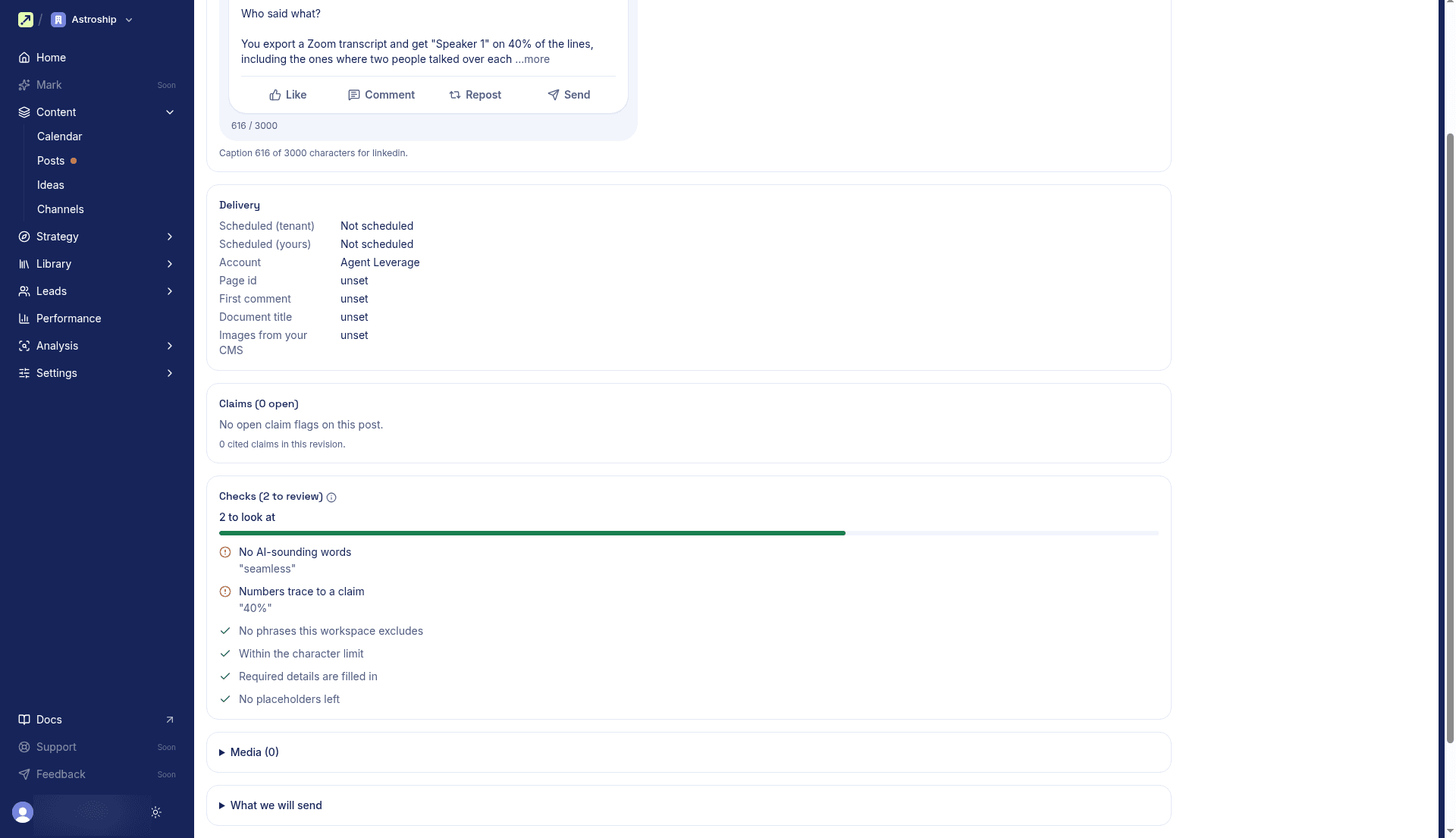
Mark runs five content checks on every draft. The checks run when an agent saves the draft and again when it goes to review, and Mark stores the results for each revision.
- Exclusion: phrases this workspace blocks or warns on.
- Character limit: the channel's length cap.
- Required fields: for a blog post, the title, slug and SEO block.
- AI fluff: generic AI-sounding words from one shared list.
- Unsourced number: percentages, money and multipliers that no confirmed claim in the workspace states.
Only a fail stops a draft from going to review. Warnings never block. Either way, a person still approves the post before anything publishes.
What we set up in Mark's own workspace
Section | What we saved |
|---|---|
Brand and voice | Positioning, four differentiators, four doctrine lines, tone, five principles, three do lines and eight don't lines. Confirmed. |
Entities and evidence | Primary entity, one secondary entity, one expert and our LinkedIn page. Confirmed. |
Exclusions | Six phrases: four block, two warn. |
Claims | None yet, so drafts stay free of numbers. |
The interview that produced this read our existing context files first and asked only about the gaps.
Where to start with your own brand
Write down three phrases you never want in a post. For each one, decide whether it should block a draft or only warn. That short list is the part of your brand rules a machine can enforce on day one, and it catches the mistakes that are most embarrassing to publish. The rest of your voice can follow.